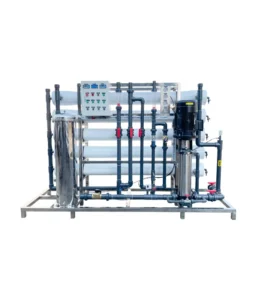
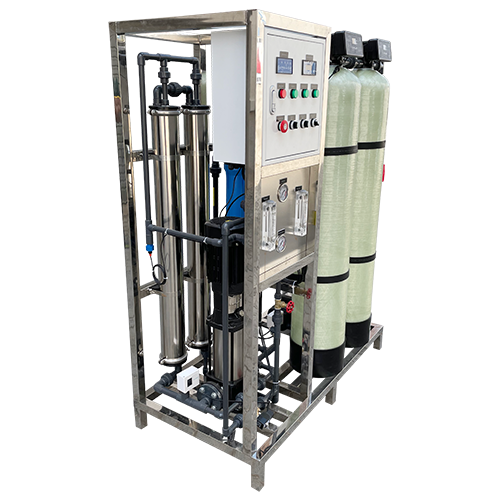
500 Litres Per Hour Industrial RO System On Skid
About Reverse Osmosis System
Reverse Osmosis is the process of removing dissolved elements from your water. For example, if you have a cup of water. Each time you add a teaspoon of sugar, The TDS will increase. So, the more sugar you add, the higher your tds will be. A filter system will not remove the sugar that’s dissolved in the water. The only way to remove what’s dissolved is the water is to put it through a reverse osmosis system.
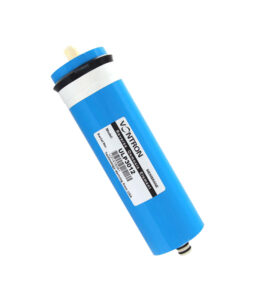
Reverse Osmosis is a technology that is used to remove a large majority of dissolved contaminants from water by pushing the water under pressure through a semi-permeable membrane. So if you have to put sweet water through the reverse osmosis system, you will have 2 outputs. Your pure water will have no taste (permeate ), and the water will be sweeter (concentrate).
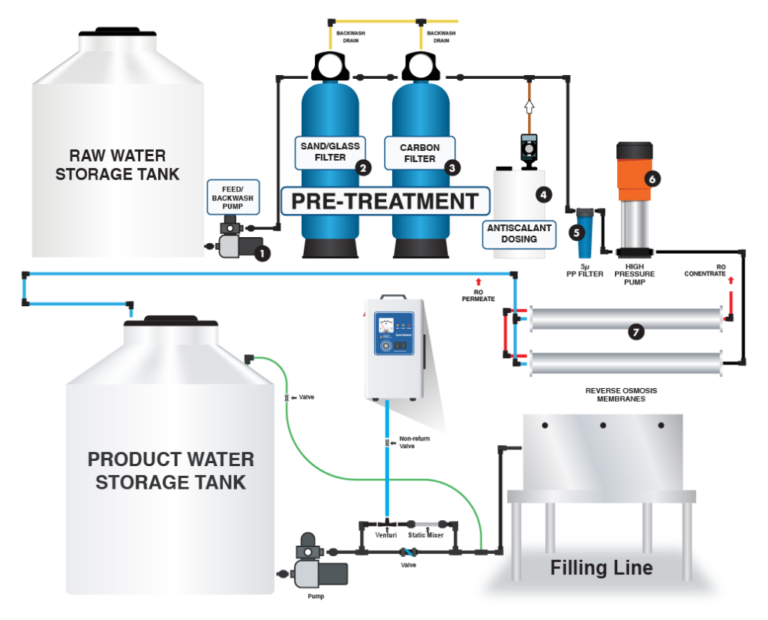
Complete RO System Plant Flow
Applications
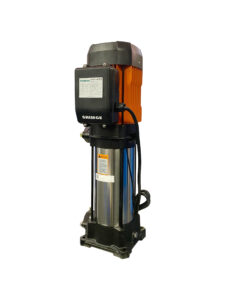
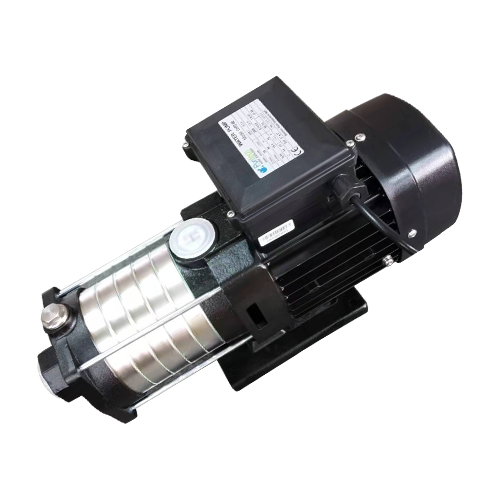
CHT series are mini horizontal centrifugal pumps, have a wide application in the domestic water supply industry and construction. They are used for:
- Air-conditioning systems
- Cooling Systems
- Industrial cleaning, conveyance, and circulation of liquid.
- Water treatment (Water Purification)
- Domestic water supply
- Boosting, environment
- Other Special usages
Working conditions
- Diluted, clean, non-flammable, and non-explosive liquids
- Liquid without solid grain or fibers
- Liquid Temperature:
- Low temperature: -20˚C ~ +70˚C
- Standard temperature: +15˚C ~ +70˚C
- High temperature: +70˚C ~ +104˚C
- Max. environmental temperature: 50˚C
- Max. operating pressure: 10 bar
- Max. Suction pressure is limited by max. operating pressure
Motor
- 2-pole induction motor;
- Three-phase: 220/380V/50Hz
- Single-phase with input thermal protector
- Insulation class: F
- Protection: IP55
- Continuous duty
Sand/Glass Filter
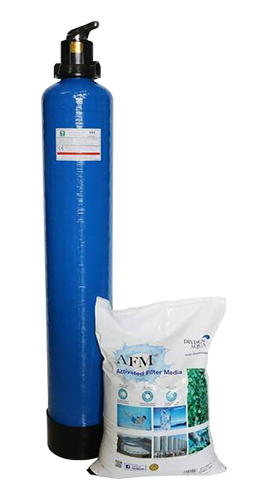
Product Description:
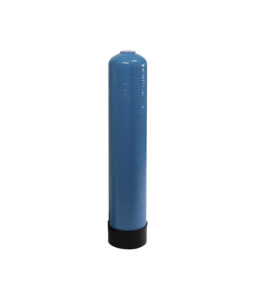
Impurities are removed from water by passing through a bed of quartzite sand of various gradations. The installation of a Sand filter is recommended when a load of turbidity (sand, lime, scales, colloids, etc.) of water is very high, affecting the water quality and resulting in deposits and encrustations on pipelines, boilers, taps, and on domestic and industrial appliances in general. Puritech Multi-Media depth filters typically remove particles 5-15 microns in size or larger. All media included in our filters are carefully selected according to particle size, so the media retains its stratification during backwash and rinse. An automatic backwashing system removes the trapped contaminants within the filter bed and washes them down the drain.
Advantages of A Sand Filter
- Turbidity Removal
- Low Maintenance Required
- Automatic or Manual Control Valves are available
- Designed to achieve High Flow Rate
Sand filters are used as a step in the water treatment process of water purification.
There are three main types; rapid (gravity) sand filters, upward flow sand filters, and slow sand filters. All three methods are used extensively in the water industry throughout the world. The first two require the use of flocculant chemicals to work effectively while slow sand filters can produce very high-quality water with pathogens removal from 90% to >99% (depending on the strains), taste, and odor without the need for chemical aids. Sand filters can, apart from being used in water treatment plants, be used for water purification in singular households as they use materials that are available for most people.
Puritech filtration equipment features an excellent design with high-quality components to offer high performance. Puritech systems are designed for the longest life span with minimum energy consumption. Experience greater savings with lower maintenance and operation costs when you install Puritech filtration equipment.
The main benefit of a sand filter is the simple system which, in many cases, can be used to obtain considerable yields. A sand filter can be placed in various phases of water management – as a pre-treatment, as side-stream filtration and as a polishing filter. A sand filter often provides an effluent with potential for re-use.
However, chemicals sometimes need to be added to improve the yield of the sand filter. A disadvantage of sand filtration is the rinse water that is created when the sand filter is cleaned. This heavily polluted water must be treated and disposed of. To limit the load on the filter, a preliminary sedimentation step is implemented for heavily loaded wastewaters (a lot of suspended and sinkable matter). This helps to avoid repetitive re-rinsing of the filter.
Discontinuous sand filters are often placed in parallel setup in order to keep the process running when one of the filters is being cleaned.
Why use sand as filter media on the water filtration and how it works?
Sand has for a long time been used to clean as well as purify the water. 4 grades of sand are majorly used for water filtration all over the world.
Today, the provision of good quality potable water is taken for granted in much of the developed world. So, how exactly does it work? Natural sand has a sub-angular to the rounded shape, that does make them ideal filtration media to be able to capture the suspended solids in the water. As a result of the high silica content, sand is durable and hard-wearing, which allows it to be graded precisely so as to facilitate efficient filtering.
Sand gets to be laid on top of the supporting layer of the gravel within the filter vessel. Incoming water enters the filter and migrates through silica sand, hence successfully removing any solid or even debris from the water. As a result of its uniqueness in terms of its properties, silica sand is usually used for water filtration in a wide variety of applications that do include swimming as well as leisure, paper processing, power generation, chemical processing, and portable as well as wastewater treatment.
In the market, there are various types that are available. The pressure filters are operated with a feed pressure of two to five bars and are usually used in leisure applications. Feedwater does enter and pass through the bed of sand. The majority of particulate solids are usually captured high up in the filter beds, this kind of filter is able to capture even the small particles. The buildup of the particulate solids does cause an increase in pressure loss across the bed for a certain given flow rate. When this pressure loss or the flow rate is not acceptable bed is back washed to be able to remove accumulated particles.
Sand/Glass Filter
Product Description:
Impurities are removed from water by passing through a bed of quartzite sand of various gradations. The installation of a Sand filter is recommended when a load of turbidity (sand, lime, scales, colloids, etc.) of water is very high, affecting the water quality and resulting in deposits and encrustations on pipelines, boilers, taps, and on domestic and industrial appliances in general. Puritech Multi-Media depth filters typically remove particles 5-15 microns in size or larger. All media included in our filters are carefully selected according to particle size, so the media retains its stratification during backwash and rinse. An automatic backwashing system removes the trapped contaminants within the filter bed and washes them down the drain.
Advantages of A Sand Filter
- Turbidity Removal
- Low Maintenance Required
- Automatic or Manual Control Valves are available
- Designed to achieve High Flow Rate